


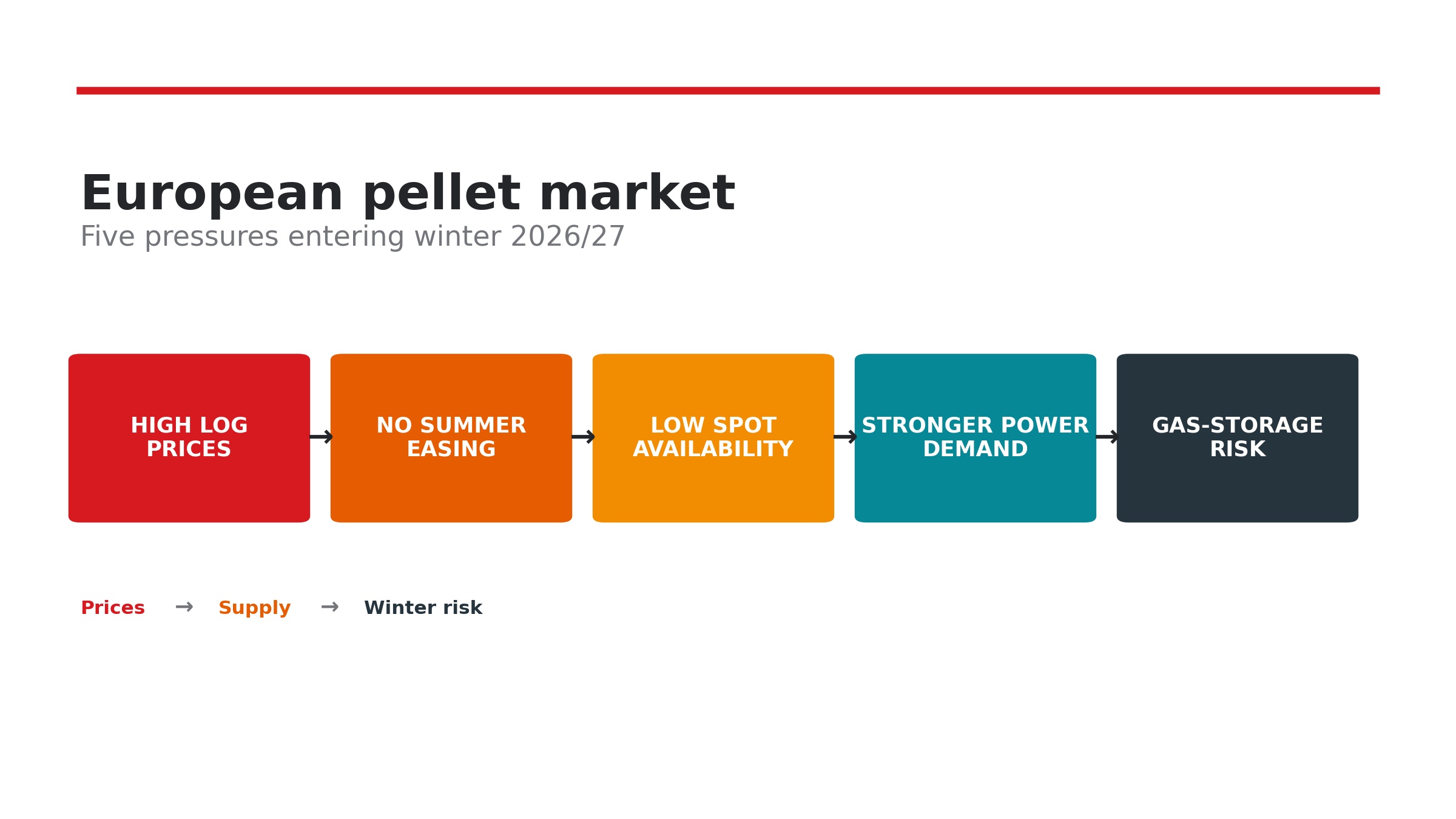
European pellet production and consumption continued to expand in 2025, but the apparent balance conceals a market increasingly divided between residential heating and large-scale industrial demand. Unusually strong summer consumption by power plants, limited spot availability and lower European gas storage levels are creating renewed price and supply risks ahead of the 2026/27 heating season.
Global Wood Markets Info (GWMI) participated in the latest Pfeifer Talk, opened by Pfeifer Group CEO Michael Pfeifer and devoted to international pellet-market developments. Pfeifer placed the discussion within the immediate commercial questions facing producers and consumers: how production and demand are developing, which factors are influencing availability and prices, and what the industry must do to preserve a functioning and dependable market.
Pfeifer also pointed to the increasingly uncomfortable relationship between log and pellet prices. European sawlog prices remain at exceptionally high levels, supported by limited availability and the sharp decline in salvage logging after a comparatively wet summer, while weak construction has prevented sawmills from passing the full increase on to softwood lumber buyers. For integrated producers such as Pfeifer, this creates a double effect: higher log costs weaken sawmilling margins, but they also raise the value of sawmill residues used for pellet production. Pellet prices therefore cannot be considered separately from the log market. If sawmills reduce output because processing has become uneconomic, less sawdust and wood chips become available, tightening pellet feedstock supply even when demand for softwood lumber remains weak.
 Thousands of quality articles